

Concept, in collaboration with students of the TU Delft (JIP).


The reserve pillar close to the labor island Neeltje Jans as a testcase.

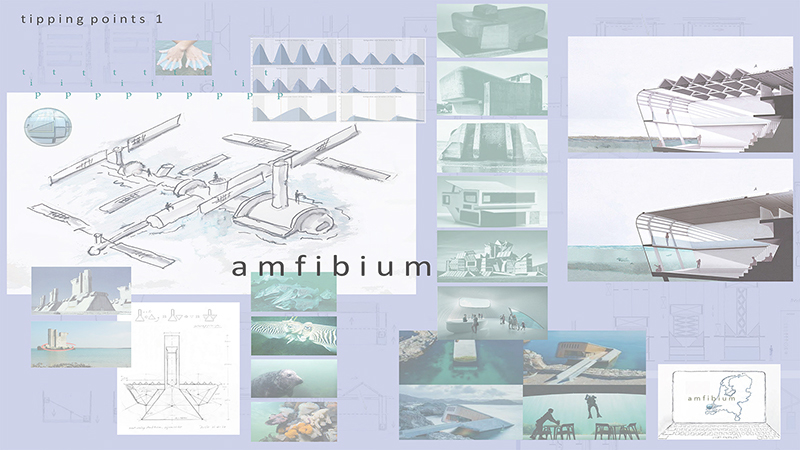

amfibium
tidal pavilion
Commission: Rijkswaterstaat (Strategische Verkenningen)/
Artist in residency
Concept: © David Veldhoen
Subject: Sea
Location: Oosterschelde, Zeeland
Status: concept 1 (no design!), Tipping points
Year: 2023 - 2026

………………
Sea-level rise unfolds so slowly that, for the average mortal, it remains an abstraction. The concept for the tidal pavilion Amfibium seeks to give form to that rise. The level at low tide functions, as it were, as the zero baseline. Inside the pavilion, as the tide comes in, visitors find themselves -quite literally- progressively below the waterline, separated only by glass.
The tide-driven kinetic architecture transforms space and light, rendering the invisible force of gravity perceptible. These tangible confrontations may sharpen a sense of responsibility and the urgency of decision-making, or allow visitors to more easily share ideas, dreams, fantasies, and fears. A visit to the Amfibium may evoke the well-known “overview effect” often experienced by astronauts.
The tide cannot be halted: as an advance on the future, we will have to learn to live in symbiosis with the advancing sea. From a societal and public perspective, both confrontation and wonder play a role. Depending on the scale of the pavilion, space is also created for insight and knowledge exchange in areas such as the development of new, environmentally friendly, seawater-resistant materials, and innovative techniques for drinking water production and energy generation.
Various locations are being explored, with particular attention to the Oosterschelde, due to its -by Dutch standards- large tidal range of an average 3.20 metres and exceptional water clarity of up to five metres (Secchi scale). A protected area within the dikes is preferred for its structural and infrastructural advantages. The harbours of Neeltje Jans on the Oosterschelde side could be suitable. During the residency, the reserve pillar of the Oosterschelde storm surge barrier served as an ideal case study. An existing offshore foundation could significantly reduce construction costs. This possibility was further investigated with students from TU Delft within the framework of the Joint Interdisciplinary Projects (JIP).
With special thanks to: Erna Oova, Andreas Heutink, Helen Nieuweboer, Eric van der Weegen (RWS); Inge Wallage (WUR) en studenten TU Delft
Publication Rijkswaterstaat: